
Extended Content Labels in Healthcare: Making More Information Work Within the Same Package Footprint
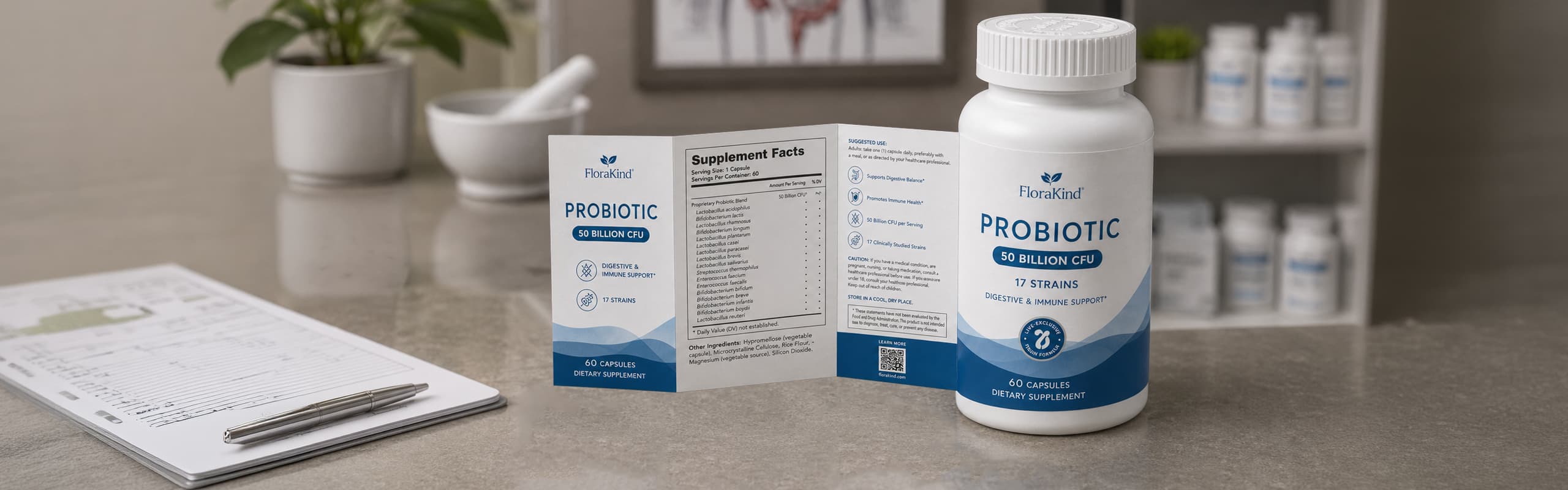
How engineered label constructions support compliance, usability, and future product growth.
Healthcare products increasingly face an information management challenge.
Patient instructions, dosage details, safety information, regulatory copy, multi-language content, UDI, serialization, barcodes, QR codes, authentication features, and traceability elements all compete for limited space on the package. As products expand into new markets and supply chains become more connected, those information requirements often continue to grow.
For small containers, curved surfaces, vials, bottles, cartons, and medical devices, available label space can disappear quickly.
The challenge is not simply fitting more words onto a package. The information also needs to remain readable, accessible, durable, and compatible with production environments.
This is where extended content labels (ECLs) can help. When properly engineered, ECLs provide a way to manage growing information requirements without increasing the package footprint or disrupting how a product is manufactured, distributed, or used.
Why Healthcare Products Have an Information Density Challenge
Healthcare products often need to communicate more information than a conventional label can effectively manage. The information requirements alone can be extensive:
- Patient instructions
- Drug facts and dosage information
- Safety warnings and regulatory copy
- Multi-language content
- UDI and serialization
- Barcodes and QR codes
- Product authentication
- Traceability information
The physical packaging makes it harder. Small containers, curved surfaces, vials, bottles, cartons, and medical devices leave limited room to work with. The challenge is not simply fitting more words onto a label. The information also needs to remain readable, accessible, durable, and compatible with the packaging line.
A well-designed ECL helps organize critical content while maintaining the package’s existing footprint. It can also create flexibility for future product changes, helping organizations accommodate additional languages, new traceability requirements, or evolving patient information without immediately redesigning the package.
What Are Extended Content Labels?
Extended content labels, or ECLs, are multi-panel, booklet, peel-back, or layered label constructions that give healthcare brands more printable space within the same package footprint.
They can help organize instructions, dosage details, safety information, regulatory copy, multi-language content, barcodes, UDI, serialization, and traceability elements while preserving usability and package performance.
Common Extended Content Label Formats
Extended content labels are not one-size-fits-all. The right construction depends on the product, container, application method, and how the end user will interact with the label.
Peel-and-Reseal Labels for Repeat Access
Peel-and-reseal labels are useful when information needs to be accessed more than once. They can support patient instructions, warnings, dosage or usage information, or multi-language copy while allowing the label to close securely after opening.
Fold-Out or Accordion Labels for Expanded Instructions
Fold-out or accordion labels provide a larger content area in a compact format. These are often used when products require detailed disclosures, multiple languages, or expanded instructions.
Booklet Labels for Structured Healthcare Information
Booklet labels are designed for more structured, multi-page content. They can be a strong fit for pharmaceutical products, clinical materials, medical devices, or products with detailed diagrams, IFU-style content, and instructions.
Multi-Layer Labels for Secondary or Traceability Information
Multi-layer labels allow information to be organized across separate layers, keeping the primary label clean while placing secondary content underneath. These constructions can also support secondary regulatory information, authentication features, barcodes, QR codes, UDI, serialization, and traceability elements.
Why Healthcare ECLs Require an Engineered Approach
In healthcare packaging, the label has to do more than carry information. It must support production requirements while remaining usable for the people interacting with the product—whether that is a patient, pharmacist, caregiver, provider, or technician.
That means the label construction should be evaluated against real-world variables such as:
- Container shape and material
- Label placement
- Line speed and application method
- Adhesive performance
- Exposure to moisture, abrasion, cleaning agents, or temperature changes
- Sterilization or use conditions
- Frequency of opening and resealing
- Readability across panels or pages
Small details can make a major difference. A label that looks right in concept may still fail if it does not apply cleanly, reseal properly, stay legible, or hold up in the product’s intended environment.
Built Around the Full Packaging System
The most effective ECL programs begin with the full packaging system in mind.
Before selecting a format, it helps to ask:
- What information is required today?
- Will future markets require additional languages or product information?
- How will the product be filled, labeled, stored, and shipped?
- Will the label need to be opened and closed repeatedly?
- What environmental, sterilization, or use conditions will the product face?
- Does the label need to support barcodes, serialization, RFID, NFC, QR codes, UDI, or other smart packaging features?
- How will patients, providers, pharmacists, caregivers, or technicians interact with the label?
From there, materials, adhesives, folds, layers, and print formats can be selected to support both compliance needs and operational performance.
Design for Tomorrow, Not Just Today
One of the most overlooked considerations when selecting an extended content label is future growth.
A label that works today may become constrained tomorrow as products expand into new geographic markets, add additional languages, incorporate new traceability requirements, or evolve patient instructions.
Designing with future requirements in mind can help reduce future redesigns while maintaining consistency across manufacturing operations. In some cases, building additional capacity into the label structure upfront can simplify market expansion without changing the overall package footprint.
This approach transforms ECLs from a short-term space-saving solution into a longer-term information management strategy that can grow alongside the product.
Questions to consider include:
- Could additional languages be required in the future?
- Might new regulatory or patient information be introduced?
- Will serialization, UDI, RFID, NFC, or other smart packaging features be added later?
- Will the product expand into new markets or distribution channels?
Planning for these possibilities early can create more adaptable packaging systems while reducing operational disruption later in the product lifecycle.
When to Consider an Extended Content Label
A healthcare brand may want to evaluate an extended content label when:
- The standard label cannot fit required instructions or warnings
- Multiple languages need to be included
- The package is small, curved, or irregular
- Information must be accessed repeatedly
- Barcodes, QR codes, UDI, serialization, or traceability elements need to be included
- The package footprint cannot be expanded or redesigned
- The label must remain durable through storage, shipping, handling, or use
- Patient-facing information must be organized clearly
In many cases, organizations evaluate ECLs not because they have run out of space today, but because they anticipate future information requirements that could outgrow the package over time.
The Bottom Line
When healthcare label space runs out, the answer is not always a larger label or a redesigned package. Sometimes, the answer is a smarter way to manage information.
Extended content labels help healthcare organizations communicate more information without increasing the package footprint. When properly engineered, they can support readability, usability, regulatory communication, and production efficiency while creating flexibility for future growth.
For pharmaceutical, medical device, OTC, and healthcare products, the value of an ECL is not simply additional printable space. It is the ability to organize critical information in a way that supports patients, providers, manufacturing operations, and evolving market requirements—while keeping the packaging system working as intended.
RLG Healthcare works with pharmaceutical, medical device, OTC, and clinical packaging teams to evaluate ECL constructions, select the right format for the application, and manage production through launch. If you’re working through a label space challenge—or planning ahead for future information requirements—we’re a practical place to start.
Frequently Asked Questions
What are extended content labels in healthcare packaging?
Extended content labels are multi-panel, booklet, peel-back, or layered label constructions that give healthcare brands more printable space within the same package footprint. They help organize instructions, dosage details, safety information, regulatory copy, multi-language content, and traceability elements without increasing package size.
When should a healthcare brand use an extended content label?
A healthcare brand may consider an ECL when required instructions, warnings, multi-language content, traceability elements, or regulatory information exceed the available label space on the package—or when future market expansion is anticipated.
Can extended content labels support UDI, serialization, or traceability?
Yes. Extended content labels can provide additional space for UDI, serialization, barcodes, QR codes, authentication features, and traceability information while keeping the primary label clean and readable.
Why do healthcare ECLs need to be engineered around the packaging system?
Healthcare ECLs must perform consistently across production, storage, distribution, and end use. Factors such as container shape and material, application method, adhesive performance, environmental exposure, sterilization conditions, and user interaction can all influence label performance.
What is the difference between a booklet label and a peel-and-reseal label?
Booklet labels provide structured, multi-page content for complex or multi-language information, while peel-and-reseal labels allow patients, providers, or caregivers to access information beneath the label and reseal it for future reference.