
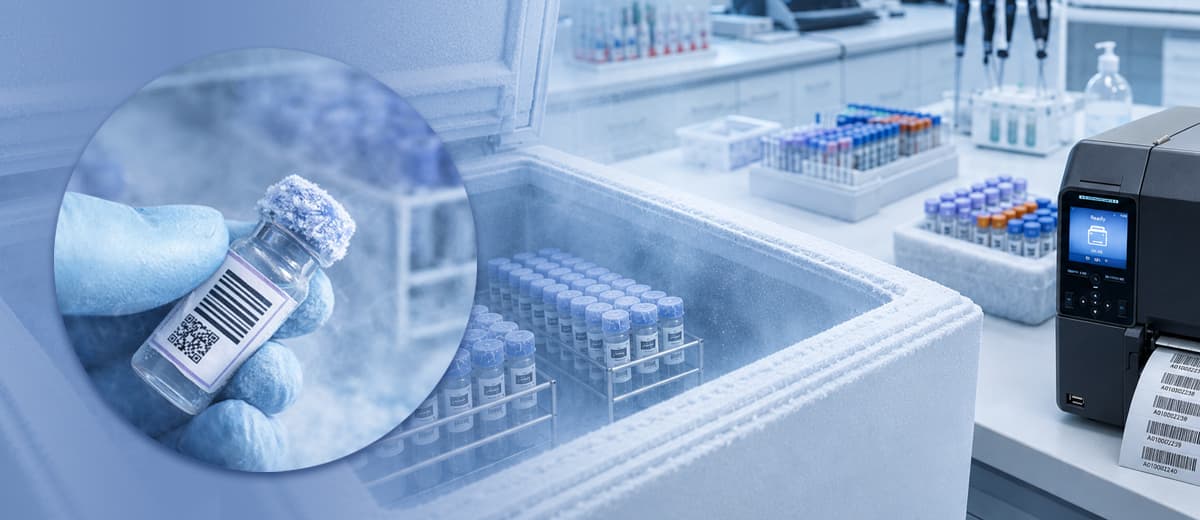
In healthcare and life sciences, labels do more than identify a product. They support traceability, carry critical information for safety and regulatory requirements, and ensure that information remains accessible in demanding environments.
In some applications, labels must perform in extreme conditions such as cryogenic freezing.
Cryogenic labels for healthcare and life sciences applications are designed to remain adhered, readable, and scannable in ultra-low-temperature storage environments, including -80°C freezers. A reliable cryogenic label system depends on more than the label material alone. Facestock, adhesive, print method, ribbon, artwork, application surface, and validation process all need to work together to protect identification and traceability through storage and handling.
When specimens are stored at temperatures as low as -112°F (-80°C), standard label materials and print methods can fail. Adhesives can break down. Facestocks can crack. Printed information can fade or become unreadable.
When that happens, the risk extends beyond packaging. It can impact specimen chain of custody, traceability, and regulatory confidence.
Why Cryogenic Labels Matter in Healthcare
In a -80°C freezer or cryogenic storage tank, a label is often the only thing connecting a vial, carton, or sample to the data behind it. If that label fails, the specimen’s identity goes with it.
For healthcare, biotechnology, and life sciences teams, that connection supports several things at once:
- Specimen identification. Vials and cartons need to stay correctly identified through freezing, storage, and retrieval, often over months or years.
- Chain of custody. Traceability depends on labels staying intact and legible at every handoff, from initial labeling through long-term storage and eventual use.
- Lab workflow continuity. When a label peels, fades, or becomes unreadable, the result is often a relabeling effort, a paused workflow, or in the worst case, a sample that can no longer be confidently identified.
- Barcode and scan reliability. Many lab workflows depend on scanning, not just reading. A label that looks fine but scans poorly can quietly slow down a process or introduce errors.
- Regulatory confidence. Consistent, validated labeling supports the documentation and traceability that regulated environments require.
This isn’t a new concern in laboratory science. Biospecimen handling guidance from the National Academies notes that specimen label adhesives should be checked to confirm labels won’t come off in the freezer or if they get wet, and that label ink should be checked to make sure it won’t smudge or run. That kind of pretesting reflects what cryogenic labeling requires more broadly: the material has to be proven in the actual storage condition, not just assumed to work ¹.
Standard labels and printing methods aren’t built for these conditions. Reliable performance at ultra-low temperatures depends on selecting and validating a label system designed for the environment, before it’s relied on at scale.
Customer Case Study
This is exactly the kind of challenge a recent RLG Healthcare project addressed. A biotechnology company needed a label system that could perform reliably in cryogenic storage, while still supporting traceability and chain of custody for vials and cartons used in laboratory testing and long-term specimen storage.
The Challenge: Labels for Ultra-Low-Temperature Storage
The customer required labels for vials and cartons used in laboratory testing and long-term specimen storage.
Their requirements went beyond basic durability.
The label system needed to:
- Withstand ultra-low temperatures without peeling, cracking, or fading
- Adhere to multiple materials, including glass vials and cartons
- Support initial use of pre-printed labels, with a future transition to in-house variable data printing
- Finalize the label design while meeting tight timelines, regulatory expectations, and budget constraints
At these temperatures, even small failures can compromise identification and traceability. This makes material selection, print performance, and validation critical.
The Approach: Engineering a Cryogenic Label System
The project required more than a standard label order. It called for a coordinated approach across materials, printing, and validation.
Here are the critical steps included in the process.
1. Material Selection and Real-World Testing
The first priority was identifying materials that could perform reliably in cryogenic environments.
- Cryogenic-rated facestocks and adhesives were selected for -80°C performance
- Sample labels were produced and tested in actual ultra-low freezer conditions
- Performance was validated before scaling to production
Testing in real conditions helped confirm that the materials would perform as expected before scale.
2. Speed Without Compromising Control
The program required fast turnaround aligned with the customer’s product rollout schedule.
- Production was coordinated to meet aggressive timelines
- Deliveries were aligned with rollout requirements
In this environment, speed still needed to be repeatable and controlled to maintain traceability and consistency.
3. Artwork and Compliance Support
Cryogenic environments introduce usability challenges. Labels still need to remain readable and scannable during storage and handling.
- Artwork was developed and formatted for clarity and scan reliability
- Layouts were optimized for laboratory use and handling conditions
- Outputs were aligned with application and compliance requirements
4. Transition to In-House Variable Data Printing
As the program evolved, the customer needed more flexibility.
Instead of relying solely on pre-printed labels, they required the ability to print expiration dates and lot codes internally.
RLG Healthcare supported this transition by:
- Evaluating the customer’s process and operational constraints
- Recommending asuitable printer for the application
- Supplying a cryogenic-compatible resin ribbon designed to prevent smudging or fading
This allowed the customer to introduce in-house printing while maintaining label performance.
5. Validation Before Scale
Before full deployment, the solution was validated through:
- Application testing
- Freezer testing
- First Article approvals
This ensured the label system performed under real-world conditions before scale-up.
Results: Performance, Flexibility, & Reduced Risk
The final solution delivered clear outcomes:
- A validated label system capable of performing at -112°F (-80°C)
- Improved operational flexibility through in-house variable printing
- Alignment with product launch timelines
- Reduced risk of label failure in critical storage environments
What This Means for Healthcare Packaging Teams
Successful use of cryogenic labels is a systems challenge, involving much more than just material selection.
In this case study, performance depended on how well multiple elements worked together:
- Material selection
- Print technology
- Artwork design
- Validation processes
- Operational workflows
When these elements are addressed together, performance is more predictable. When addressed separately, issues are more likely to appear on a scale.
A Partner Approach to Labels
This project reflects a broader pattern in healthcare packaging. Customers shouldn’t just look for a supplier to print labels, but rather a partner who can:
- Evaluate application requirements holistically
- Reduce risk through testing and validation
- Support evolving operational needs over time
In this case, evaluating materials, printing requirements, and validation early helped support a label system designed to perform in ultra-low-temperature environments.
The Bottom Line
For healthcare and life sciences applications, the difference between a label that performs and one that fails is often determined before production begins.
RLG Healthcare Can Help Develop Successful Cryogenic Label Solutions
Need cryogenic labels for healthcare, life sciences, or laboratory applications? RLG Healthcare can help evaluate your application, recommend materials, support testing, and build a label system designed for performance in ultra-low-temperature environments.
Speak to one of RLG Healthcare’s team members to learn how we can support your application.
Frequently Asked Questions
Why do labels fail in cryogenic storage at -80°C?
At ultra-low temperatures, standard label materials and print methods may not perform as expected. Adhesives can lose adhesion, facestocks can crack, and printed information can fade or become difficult to read. Performance depends on selecting materials designed for cryogenic environments and validating them through real-world testing.
What types of applications require cryogenic labels in healthcare?
Cryogenic labels are used in laboratory testing and long-term specimen storage, including applications involving vials and cartons. In these environments, labels must remain adhered readable, and scannable to maintain identification and traceability.
What should be validated before using cryogenic labels at scale?
The full label system should be tested under real-world conditions. This includes application testing, freezer testing, and First Article approvals to confirm adhesion, readability, and overall performance before deployment.
Can cryogenic labels support in-house variable data printing?
Yes, but the label system must be compatible with the printing process. Supporting expiration dates and lot codes requires alignment between label materials, ribbon, and printing equipment to maintain print durability and readability.
Why is cryogenic labeling considered a system challenge?
Cryogenic labeling performance depends on how multiple elements work together, including materials, adhesives, print technology, artwork, and validation processes. Addressing these factors together helps reduce risk and improve performance in ultra-low-temperature environments.
Citations
¹ National Library of Medicine, Collecting, Storing, Using, and Distributing Biospecimens