RFID Tag Types and Frequency Comparison

Radio frequency identification, or RFID, is a broad category of smart labels. It encompasses near field communication tags, ultra-high-frequency tags, high-frequency tags, and low-frequency tags. Understanding the differences between each type is essential to deploying the right solution.
RFID technology relies on radio waves to send and receive information between a tag and a reader. The reader sends a signal to the tag, and the tag responds with a signal carrying the stored information.
Each individual RFID tag can be programmed with unique information, such as a GS1 Electronic Product Code. Tags can be affixed to products, boxes, pallets, or high-value equipment depending on the application.
RFID tags hold a clear advantage over barcodes. Because radio waves require no direct line of sight, entire pallets or truckloads can be scanned at once. Readers can process up to 700 products per second, driving visibility and efficiency across the supply chain.
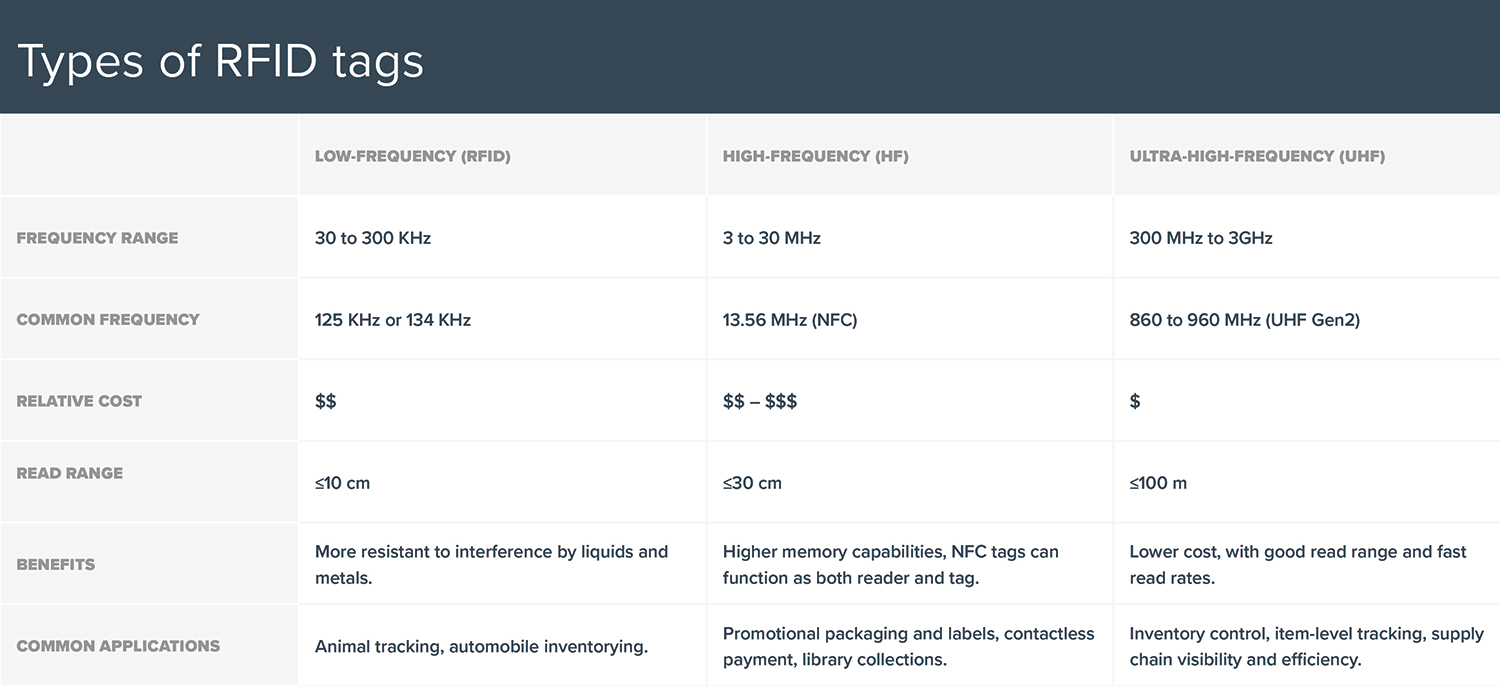
Low-frequency tags (30 KHz to 300 KHz) have slower read rates and shorter ranges. However, their longer wavelength makes them less susceptible to interference from liquids and metals. They are commonly used on metal substrates like beer kegs or automobiles.
High-frequency tags (3 to 30 MHz) offer longer read ranges and higher memory capacity. They are well-suited for cataloging library media or tracking wristbands at theme parks.
NFC tags are a subcategory of high-frequency tags operating at 13.56 MHz. They have a much shorter read range, typically requiring the reader and tag to be within a few centimeters of each other. Their larger memory capacity and two-way communication make them valuable for promotional campaigns and contactless payment applications like Apple Pay.
Ultra-high-frequency tags (300 MHz to 3 GHz) are considered the supply chain frequency. They are generally lower in cost while delivering solid read ranges and speeds. Common applications include item-level tracking and retail inventory control. Walmart, Target, and the Department of Defense all mandate that suppliers attach RFID tags to every product and pallet, allowing hundreds of tags to be read simultaneously and reducing the need for manual inventory counts.
RFID tags also differ by power source. Active tags contain a battery that periodically transmits signals, making them useful for location tracking with read ranges up to 100 meters. Passive tags have no battery and remain dormant until a reader signal activates them, using that energy to power on and reflect information back. Semi-passive tags contain a battery but do not transmit on their own – the battery simply powers the tag when a reader signal is received.
Resource Label Group has more than 20 years of experience designing scalable RFID solutions for large companies.
What are RFID tags?
RFID technology relies on radio waves to send and receive information between a tag and a reader. At its simplest level, an RFID reader sends a signal out to an RFID tag and the tag sends back an information-carrying signal. Unique information —such as a GS1 Electronic Product Code™ (EPC)— can be programmed into each individual RFID tag, which are then affixed to products, boxes, pallets or even high-value equipment depending on the application.
It’s easiest to explain RFID tags (or labels) by comparing them to barcodes. Similar to barcodes, RFID tags are commonly used to quickly retrieve product- or pallet-level information. But because RFID tags use radio wave technology, they don’t require direct line-of-sight in order to be read — meaning entire pallets or truckloads of products can be read as quickly as 700 products per second. This gives RFID tags a clear advantage when it comes to driving visibility and efficiency at the supply chain level (called smart label tracking).
Beyond distribution and supply chain benefits, many brands are leveraging RFID tags to engage with their customers at a personal level, allowing consumers to access educational content and / or product-specific landing pages by scanning the label.
Comparing RFID tag types: UHF vs. HF vs. NFC vs. LF RFID
There are a variety of RFID tags on the market today, differentiated by frequency range (low, high and ultra-high). Each RFID type can be either active (powered), passive (un-powered) or semi-passive (battery-assisted).
Low-frequency (LF) RFID tags: 30 KHz to 300 KHz
LF RFID tags have slower read rates and shorter read ranges than UHF or HF, but they’re less susceptible to interference by liquids and metals because they have a longer wavelength. Because of this, they’re often used in applications where an RFID label is affixed to a metal substrate, such as inventorying beer kegs or automobiles.
High-frequency (HF) RFID tags: 3 to 30 MHz
HF RFID tags have longer read range and higher memory capabilities, making them well-suited to cataloging library media or for use in tracking bracelets for theme parks. Within the HF RFID category are a common type of smart label: Near field communication (NFC) tags.
- NFC vs. HF RFID
NFC tags are a subcategory of HF RFID technology. All NFC tags are HF RFID tags, but not all HF RFID tags are NFC tags. NFC operates in a very specific subset of the high-frequency range —13.56 MHz— and have very different use cases and implementation considerations from other RFID categories. - Key differences between NFC and other RFID categories
One key difference is that NFC tags have a much smaller read range, often requiring the reader and tag to be no more than a few centimeters apart. And while other RFID types allow for entire pallets of tags to be read at once, NFC tags must be read one at a time. With larger memory capabilities and two-way communication capabilities, though, NFC tags are much more useful for storing and communicating large amounts of information — making them an incredibly valuable tool in promotional campaigns. - Applications for NFC tags
NFC technology provides secure, one-to-one coupling, making it useful for contactless payment applications such as ApplePay™. And because almost all smartphones function as NFC readers, NFC tags are popular in promotional labels and posters, and are also a good tool for personalized customer engagement. To learn how brands have leveraged NFC technology, read our articles on NFC applications in wine labels or in the healthcare industry.
Ultra-high-frequency (UHF) RFID tags: 300 MHz to 3GHz
UHF RFID tags are considered the “supply chain frequency” because they’re generally lower priced than the other types, while still providing good read ranges and rates. Common applications include item-level tracking, retail inventory control and driving supply chain efficiencies.
Wal-Mart, Target and the Department of Defense (DoD) mandate that their suppliers provide RFID tags with every product and pallet. This reduces the need for manual inventorying, as hundreds of tags can be read simultaneously. And it allows them to more accurately identify incoming inventory by reading entire truckloads of products at a time.
Active, passive and semi-passive RFID tags
Active RFID tags have a battery and periodically transmit signals, useful in location tracking applications. Because the battery in active tags can boost signal strength, they tend to have a longer read range (up to 100 meters).
Passive tags remain dormant until they receive a radio signal from a reader. The energy from the reader’s signal is used to turn the tag on and reflect an information-carrying signal back to the reader.
Semi-passive (or battery-assisted) RFID tags contain a battery, but do not transmit a periodic signal like active RFID tags. Instead, the battery is only used to turn the tag on when a signal is received — this allows all energy from the reader’s signal to be reflected back.
Because active tags tend to be much more expensive, they are often only used to track very high-value assets, such as equipment in the construction, automobile or healthcare industries. Passive tags —especially ultra-high frequency (UHF) and near field communication (NFC)— are the most widely used for product and pallet labels.
Beyond tags: Looking at the entire RFID system
While tags are integral to the success of your RFID application, they don’t tell the whole story. There are four key components to an RFID system: The tags, readers, antennae and the RFID information processing system. And to ensure each of these four components work together in perfect harmony, you’ll need to enlist a label converter experienced in deploying RFID solutions at scale.
At Resource Label Group, we have more than 20 years of experience in designing scalable RFID solutions for large companies looking to leverage the value of supply chain visibility, customer engagement — or any other use case.
Reach out to us today to start a conversation about your RFID application. With customers ranging from DoD suppliers to top 100 Wal-Mart suppliers to airports looking for luggage tracking solutions, we have the expertise and bandwidth to partner with you to design any RFID solution at any scale.