When Space Runs Out: How Extended Content Labels Solve Real Packaging Challenges
There’s a point where every package hits the same wall; the label runs out of space. It’s not a design issue. It’s not a printing issue. It’s a space problem.
The package often can’t keep up with what the product needs to communicate. Why? Regulatory copy expands, instructions get longer, multiple languages are required or Marketing wants more room to communicate. Suddenly, the available label area can’t support what the product needs to say.
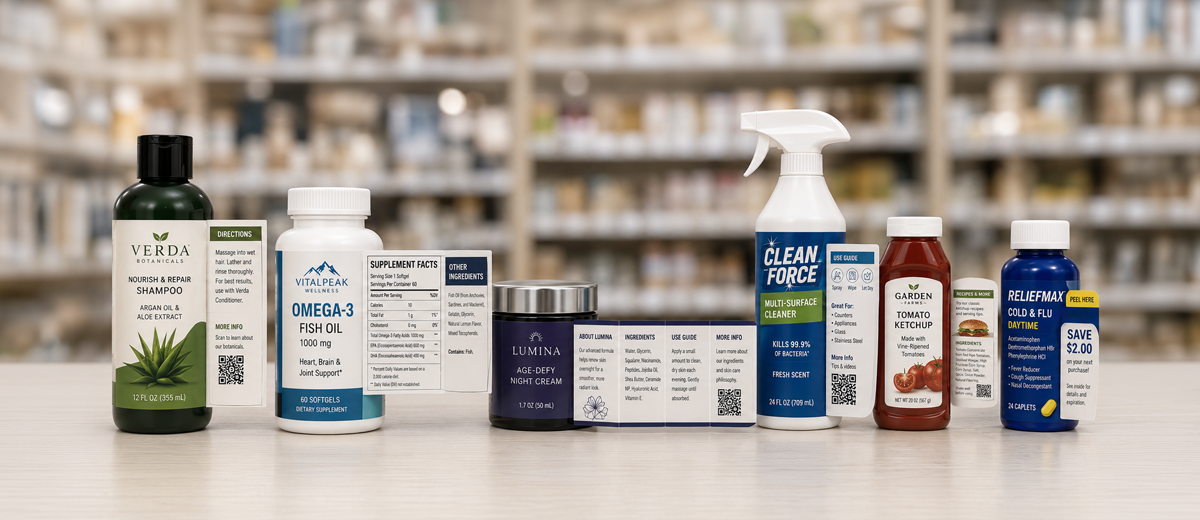
That’s where extended content labels (ECLs) come in, a category of solutions designed to deliver more information without changing the package itself. However, it’s important to know that ECLs aren’t a single product, nor a one-size-fits-all remedy.
ECLs are engineered label solutions designed to solve a very specific problem; how to deliver more information without disrupting how a product is produced, handled, and used.
Why Space Has Become an Issue in the Labels and Packaging
Across industries, the pressure on label real estate continues to increase:
- Healthcare & Pharmaceuticals require detailed instructions, compliance information, and multi-language content.
- Cosmetics & Personal care products balance regulatory copy with brand storytelling & ingredient transparency.
- Chemical products need clear safety data, handling instructions, & hazard communication.
- Food & Beverage products are adding certifications, sourcing information, & consumer incentives, like coupons.
The challenge isn’t just more content; it’s more information that still has to work within the realities of the package, including:
- Limited surface area.
- Curved or irregular containers.
- High-speed application.
- Exposure to moisture, oils, or abrasion.
- Consumer interaction (opening, resealing, & readability).
Types of Extended Content Labels and How They Work
One of the biggest challenges with extended content labels is language. Terms like booklet, peel-back (or peel & reseal), fold-out, and multi-layer labels are often used interchangeably, even though they function very differently.
Instead of focusing on product names, it’s more useful to think in terms of how each label works.
Peel & Reseal Labels
Best for: Moderate content expansion with repeat access.
Peel & reseal labels open like a cover and reseal after use. They’re commonly used when consumers need to reference information more than once.
Typical use cases:
- Healthcare instructions & dosage information.
- Personal care products with multi-language content.
- Nutraceutical packaging with detailed usage guidance.
For round containers, wrap-around peel-and-reseal formats can extend content even further while maintaining usability.
With peel and reseal labels, end user performance is key, such as:
- Adhesive performance over multiple openings.
- Clean separation without tearing.
- Alignment with automated application.
Fold-Out / Accordion Labels
Best for: Maximum content in a compact footprint.
These labels expand outward, often in multiple panels, to deliver a large amount of information without increasing the label size on the container.
Typical use cases:
- Chemical & industrial safety information.
- Regulatory-heavy products requiring detailed disclosures.
- International products with multiple language blocks.
Performance evaluations include:
- Fold precision and consistency.
- Legibility across panels.
- Durability during handling and transport.
Booklet Labels
Best for: Structured, high-volume information.
This product incorporates a printed booklet attached to the label, allowing for organized, multi-page content.
Typical use cases:
- Pharmaceutical patient information.
- Clinical or trial materials.
- Products with detailed instructions or diagrams using booklet labels.
Performance evaluations include:
- Page integrity & binding.
- Integration with the label construction.
- Compatibility with filling & labeling lines.
Multi-Layer / Dual-Layer Labels
Best for: Hidden or secondary information without changing the outer appearance.
These labels separate content into layers, allowing primary branding on the outside and additional information beneath.
Typical use cases:
- Promotional or variable content.
- Secondary regulatory information.
- Track-and-trace or authentication elements using dry release and multi-layer labels.
Performance evaluations include:
- Material stack & thickness.
- Print alignment between layers.
- Consistent performance at speed.
Why Extended Content Labels Are Rarely Off-the-Shelf
In theory, this listing of extended label types sounds at least initially, straightforward. In practice, however, they are highly dependent on the entire packaging system in order to be successful.
Small packaging variables like these can impact an extended label’s effectiveness.
- Container shape & material.
- Application method & line speed.
- Environmental exposure (moisture, friction, & temperature).
- The way an end user interacts with the label.
That’s why ECLs aren’t typically selected from a catalog.
They’re developed through a consultative, engineered approach. Small variables can change everything, and overlooking them is where most ECL programs fail.
Engineering Extended Content Labels to Fit the System
The most successful ECL programs start with questions, such as:
- How is the product filled & labeled?
- Where will the label sit on the container?
- How often will it be opened?
- What conditions will it experience in the field?
- What information is truly required, and how should it be organized?
Answering these questions will provide guidance on these important considerations.
- Selecting the right materials & adhesives
- Designing the structure (folds, layers, or booklet integration).
- Testing for durability & usability.
- Ensuring the label runs consistently in production.
Where Extended Content Labels Deliver the Most Value
Extended content labels aren’t just a workaround for space constraints. When done right, they improve how products function in the real world.
They help:
- Maintain compliance without sacrificing design.
- Keep critical information accessible & readable.
- Support multi-market distribution without multiple SKUs.
- Improve user experience through better organization of content.
And just as important, they do it without disrupting production or slowing down operations. For brands managing complex labeling requirements, the difference isn’t just the label format. It’s how well that format is engineered to perform across the entire lifecycle.
The Bottom Line
When label space runs out, the answer isn’t always a bigger label or a different package. Sometimes, it’s a smarter, better-engineered label.
Extended content labels give brands the flexibility to communicate more, meet requirements, and maintain shelf presence, within the same footprint. But the difference between a label that works and one that creates issues usually comes down to how it’s developed.
Not as a product.
But as a solution built around the system it has to perform in.